
Quranic Arabic Course: Learn to Understand the Quran, 1:1 Online
You have read Al-Fatiha thousands of times. You may know every word of it by heart. But do you know what the words mean, one by one, as you say them?
That gap between reciting and understanding is what this course closes. In 1:1 live classes with a personal teacher, you learn the Arabic of the Quran through the Quran itself: the words, the roots, the grammar, and then the verses. You can browse all Quran courses to see where this fits, or keep reading for exactly what you will understand at each stage.
Taqwa Foundation has taught more than 5,500 students since 2009, with qualified male and female teachers. Two trial classes are free, with no obligation.
Reviewed by the Taqwa Foundation teaching team.
What is Quranic Arabic, and why it’s not “learning Arabic”
Quranic Arabic is the classical Arabic of the Quran. You study its vocabulary and grammar through the verses themselves, not through conversations about airports and restaurants.
This matters because most “learn Arabic” products teach Modern Standard Arabic, the language of news broadcasts and formal writing. Useful, but different. Quranic Arabic has its own vocabulary, its own verb patterns, and its own sentence structures, and the fastest way to learn it is directly from the text you actually want to understand.
Take one line of Al-Fatiha: “Iyyaka na’budu wa iyyaka nasta’in.” You already say these words in every salah. In this course you learn that “iyyaka” means “You alone,” that “na’budu” is “we worship” built from the root letters ayn-ba-dal, and why the sentence puts “You” first. Every verse you recite starts opening up this way.
What you will understand, stage by stage
The course moves through the three classical sciences of the language: morphology, then grammar, then rhetoric. Each stage ends with something you can actually do, not a unit count.
- 1
Stage 1: Arabic Morphology (Sarf)
Sarf is how words are built. Almost every Arabic word grows from a root, usually three letters, and changing that root’s pattern turns it into a verb, a noun, a doer, a place or a tense. Learn the patterns and you stop meeting words one at a time: you recognise a word you have never seen because you know the shape it is standing in.
- 2
Stage 2: Arabic Grammar (Nahw)
Nahw is how words behave together. It is syntax and word endings, the case markings (i’rab) that tell you who did what to whom, and which word governs which. This is the stage where a verse stops being a line of familiar words and becomes a sentence you can follow.
- 3
Stage 3: Arabic Rhetoric (Balagha)
Balagha is why it was said that way. Word order, metaphor, emphasis, what is left unsaid: the choices that give Quranic expression its force. Two sentences can carry the same information and land completely differently, and this stage is where you start hearing that.
Book your 2 free trial classes and start with a placement check, free and with no obligation.
How the 1:1 classes work
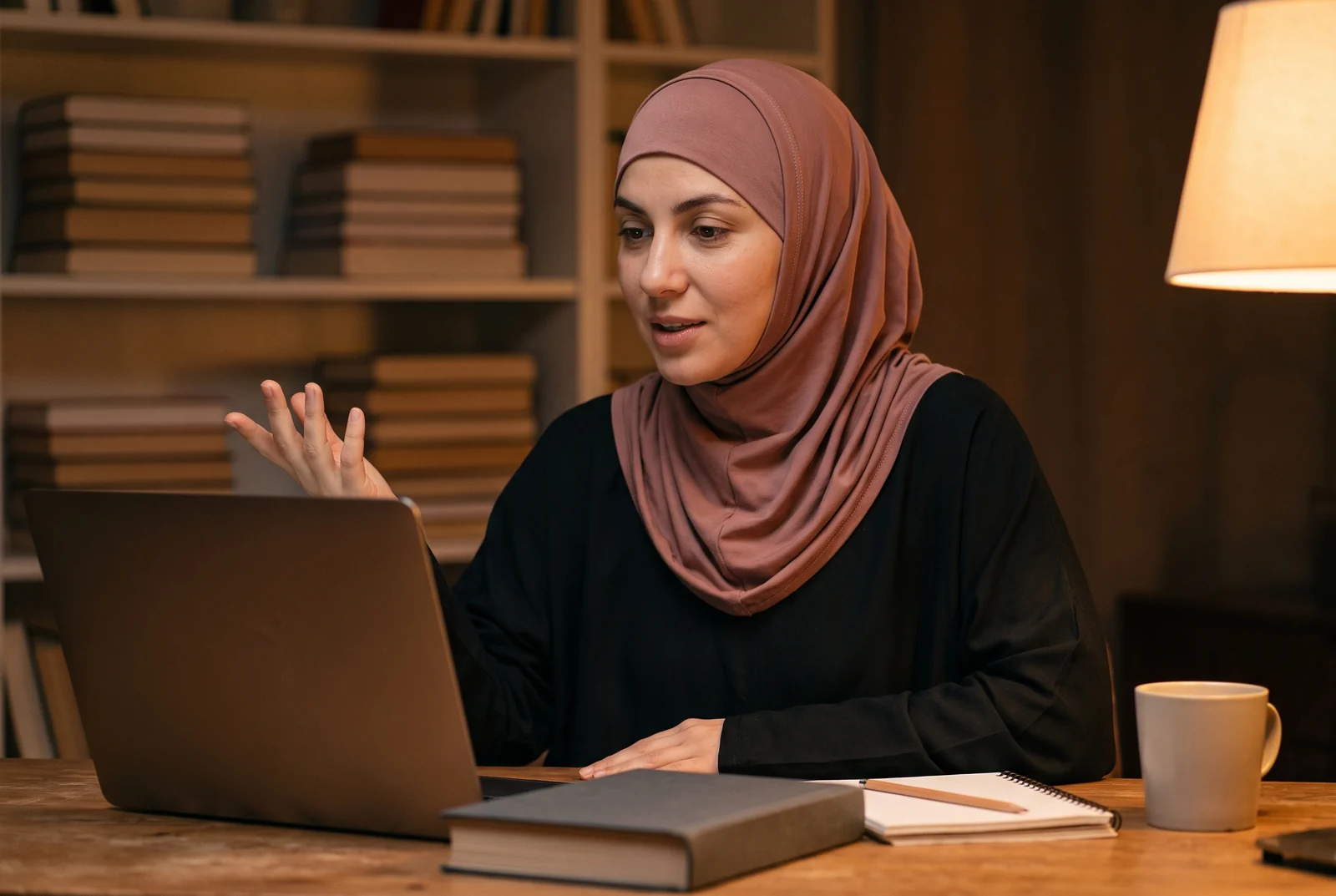
Every class is live, one-on-one, with your own teacher. Standard classes are 30 minutes, long enough to make real progress each week and short enough to fit a working adult’s evening.
You start with a placement assessment, so a true beginner and a returning learner who studied years ago each begin at the right stage. Nobody repeats what they already know, and nobody is dropped into grammar before they can read comfortably.
Scheduling is flexible across US, UK, Canada, Australia and New Zealand timezones, and classes run over Zoom, Skype, Google Meet, or WhatsApp. Most families who take both trial classes choose to stay.
How long does it take to learn Quranic Arabic?
Honestly: it depends on your weekly pace, and no honest teacher will promise you a deadline. What we can give you is what our students typically experience, built on 15+ years of teaching this course.
Most students get there somewhere between six months and two years, and age makes a real difference to which end you land on. More classes per week moves this faster; a gentler pace stretches it.
These are typical ranges, never guarantees. Your teacher will give you an honest read on your own pace after the placement assessment.
Your Quranic Arabic teacher
The top question every student has is the right one: who will actually teach me?
Your teacher is a qualified teacher of Arabic and Quran, vetted before they teach a single Taqwa student. Male and female teachers are available, and you can meet our teachers before you decide anything.
That is what the free trial is for. You meet the teacher, you experience the method, and only then do you choose.
Where this fits with tajweed and recitation
Understanding the words of the Quran and perfecting its recitation are two different skills. This course teaches the language; tajweed trains the articulation and rules of beautiful recitation (makharij, the rules of noon sakina, and so on). Many students take both, and the two strengthen each other. If recitation is your priority, see the tajweed course.
What it costs
This course starts at $75/month for 2 classes a week and rises to $100/month for 5, with the monthly fee set by your weekly class frequency. Households learning together pay less: 2 students get 25% off the total, 3 or more get 50% off. There is no contract, and you can cancel anytime.
| Weekly rhythm | Per month | Suits |
|---|---|---|
| 2 classes per week | $75 | Steady progress through sarf and nahw alongside work. |
| 5 classes per week | $100 | An immersive pace that shortens the path considerably. |
Taqwa Foundation is a US-registered business, with local payment options in the US, Canada, Australia and New Zealand.
Sponsor a student
Some families cannot afford classes. If you would like to cover a student’s monthly fee, in part or in full, mention it when you book and our team will arrange it quietly.
Frequently asked questions
What is the difference between Quranic Arabic and spoken Arabic?
Quranic Arabic is the classical language of the Quran, studied through the verses themselves. Spoken and Modern Standard Arabic are for conversation, news, and daily life. If your goal is understanding the Quran, this is the direct path.
How long does it take to understand the Quran in Arabic?
Most students get there somewhere between six months and two years, depending on age and on how much Arabic you can already read. Typical ranges, never guarantees.
Do I need to read Arabic before starting?
No. The placement assessment routes true beginners correctly. If you cannot read the Arabic letters yet, you start with the Noorani Qaida course first, then move into Quranic Arabic.
Can I learn Quranic Arabic online as an adult?
Yes. Most students in this course are adults, with pacing built for working schedules and evening or weekend classes. See how classes work on our Quran classes for adults page.
Is this course suitable for kids?
It suits older children and teens who already read Arabic comfortably. Younger children start with the Noorani Qaida course to build reading first.
What happens in the free trial classes?
Two real 1:1 classes with a teacher: you meet them, experience the method, and get a placement check so you start at the right stage. No payment, no obligation.
Book 2 free trial classes
The trial is the honest way to decide. Two free classes, no payment and no obligation. You meet your teacher, take the placement check, and see exactly how the course feels before spending anything.
Book your 2 free trial classes